
The association between obstructive sleep apnea and psychiatric disorders: a population-based risk analysis
C.-Y. Kao1,2, Y.-H. Hsieh1
1Institute of Medicine, Chung Shan Medical University, Taichung, Taiwan, 2Chung Shan Medical University Hospital, Psychiatry, Taichung, Taiwan
Background: Obstructive Sleep Apnea (OSA) is associated with a range of psychiatric disorders, including depression, anxiety, bipolar disorder, and schizophrenia, likely due to the physiological disruptions caused by intermittent hypoxia and sleep fragmentation.
Aims & Objectives: To assess the risk differences for psychiatric disorders in patients with OSA compared to those without OSA.
Method: Design, Setting and Participants: A retrospective cohort study using de-identified electronic health records from the TriNetX US Network, including adult patients aged 18-65 who had at least two medical examinations between 2016 and 2023. After propensity score matching, 360,708 patients were included in both OSA and non-OSA cohorts.
Exposures: Diagnosis of OSA, as recorded in medical records with ICD-10 code G47.33.
Main Outcomes and Neasyres: Incidence of psychiatric disorders, specifically schizophrenia, bipolar disorder, depressive disorders, and anxiety-related diseases, tracked over an 8-year period.
Exposures: Diagnosis of OSA, as recorded in medical records with ICD-10 code G47.33.
Main Outcomes and Neasyres: Incidence of psychiatric disorders, specifically schizophrenia, bipolar disorder, depressive disorders, and anxiety-related diseases, tracked over an 8-year period.
Results:
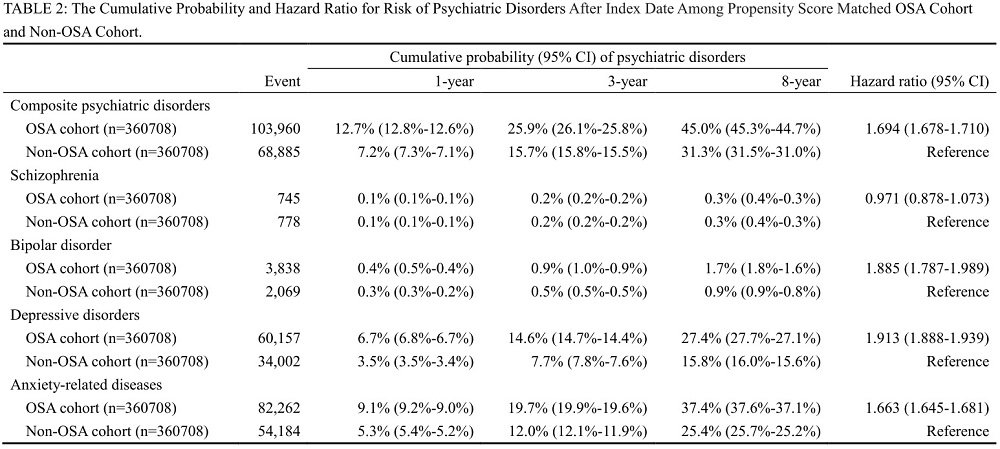
Discussion & Conclusions: This study highlights the heightened risk of psychiatric disorders in OSA patients, suggesting that comprehensive management should incorporate mental health assessments to improve overall outcomes in this population.
In sessions