
Optimizing sham control in transcutaneous auricular vagus nerve stimulation for chronic insomnia: a pooled analysis from two randomized clinical studies
Z. Qin1, J. Wu2, Y. Wang3, Y. Wu1
1Peking University, Clinical Research Institute, Beijing, China, 2Massachusetts General Hospital, Harvard Medical School, Psychiatry, Boston, United States, 3China Academy of Chinese Medical Sciences, Acupuncture and Moxibustion, Beijing, China
Background: In recent years, transcutaneous auricular vagus nerve stimulation (taVNS) has emerged as a promising intervention for insomnia, given its established efficacy in treating other conditions like depression, epilepsy, and migraines. A key methodological aspect of taVNS research is the choice of control conditions, as different sham controls can influence the interpretation of clinical efficacy. In the TASC-I study, the control group used minimal-intensity vagus nerve stimulation (tmVNS) at 0.1mA, while the TVNS-I study employed a non-auricular vagus nerve stimulation (tnVNS) sham control that applied stimulation to non-auricular sites with identical current intensity. These differing sham conditions provide an opportunity to explore the effect of sham control selection on study outcomes in taVNS trials for insomnia.
Aims & Objectives: The current pooled analysis aims to evaluate the effectiveness and safety of taVNS across different sham control conditions (tmVNS vs. tnVNS) and to determine an optimal control setting for future taVNS trials.
Method: This was a pooled, post-hoc analysis of two randomized sham-controlled studies (TVNS-I and TASC-I). Both studies were registered on www.chictr.org.cn (ChiCTR15007374, ChiCTR2100051319). In the TVNS-I study, patients received taVNS or transcutaneous non-vagus nerve stimulation (tnVNS) 5 times weekly for 6 weeks. In the TASC-I study, patients received taVNS or minimal taVNS (mi-taVNS) 5 times weekly for 8 weeks. The comparison effect of two sham control was analyzed in patients with chronic insomnia. Baseline demographics were reported descriptively using the included population who received 4-week intervention.
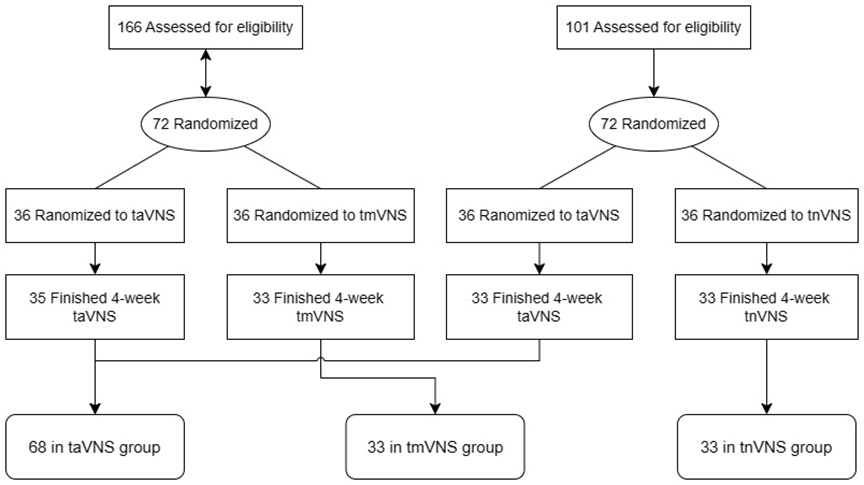
Results: A total of 144 patients were enrolled in the two studies. In total, 134 patients with baseline and 4 weeks PSQI data were included in the pooled analysis. 68 patients received taVNS for 4 weeks, 33 patients received tnVNS for 4 weeks, and 33 patients received tmVNS for 8 weeks. At week 4, the change from baseline on PSQI of taVNS, tnVNS, and tmVNS is -5.63 (95% CI -7.07 to -4.19), -4.09 (-6.16 to -2.02), and -2.64 (-4.64 to -0.64), respectively. The p-value for all group comparison is 0.004. The pairwise comparison of taVNS vs. tnVNS, taVNS vs. tmVNS, and tnVNS vs. tmVNS is 1.56 (-0.09 to 3.20, p=0.063), 2.93 (1.51 to 4.35, p<0.001), and 1.38 (-0.06 to 2.81, p=0.060).
Table 1. Baseline demographics and characteristics of participants from two trials
Table 1. Baseline demographics and characteristics of participants from two trials
| Characteristic | taVNS (N=72) | tnVNS (N=36) | tmVNS (N=36) | P value |
| Mean age (SD), y | 46.9 (14.2) | 49.8 (12.5) | 44.6 (13.9) | 0.446 |
| Sex (%) | 0.409 | |||
| Male | 18 (25.0) | 7 (19.4) | 5 (13.9) | |
| Female | 54 (75.0) | 29 (80.6) | 31 (86.1) | |
| Body mass index, mean (SD) | 25.8 (4.5) | 25.1 (4.3) | 25.5 (4.6) | 0.889 |
| Tea or Coffee consumption (%) | 0.119 | |||
| ≤1 time/d | 61 (84.7) | 33 (91.7) | 35 (97.2) | |
| ≥2 time/d | 11 (15.3) | 3 (8.3) | 1 (2.8) | |
| Baseline PSQI score, mean (SD) | 13.8 (2.6) | 12.8 (2.0) | 13.3 (2.4) | 0.145 |
Discussion & Conclusions: TnVNS showed promising neuromodulation effect which is similar to taVNS, which means imprecise location of taVNS did not eliminate the effects of stimulation. On the contrast, tmVNS is an appropriate sham control to mimic taVNS and avoid the main biological effects from taVNS. A longer period taVNS treatment is recommended for chronic insomnia.
In sessions