
Beyond the hype: examining the therapeutic potential of psychedelic microdosing through the lens of experimental control and evidence
O. Mallon1
1Imperial College London, Department of Brain Sciences, London, United Kingdom
Background: The practice of psychedelic microdosing has grown outside of the medical realm from a community of self-medicating users who endorse improvements in cognitive functioning and mental health. The breadth and strength of this advocacy has led many to replace traditional psychotropic medication and well-being support with an under researched practice. This represents a divide between public perceptions and evidence-based medicine, which raises due concern among healthcare practitioners who lack the information to responsibly advise patients on the suitability and risks of microdosing.
Aims & Objectives: The Tree of Evidence (ToE) aims to bridge this clinical knowledge gap by mapping all empirical findings on microdosing along a hierarchy of scientific rigour, assessing the extent to which current research supports, or struggles to support, its purported benefits.
Method: A PRISMA-guided systematic review identified 48 eligible studies on psychedelic microdosing published before November 2024. Human trials using sub-perceptual doses of classic psychedelics were included, excluding studies where microdoses were active placebos in macrodose research. Quality assessment following a GRADE-based model was used to rank studies, with findings mapped into a visual hierarchy of evidence.
Results:
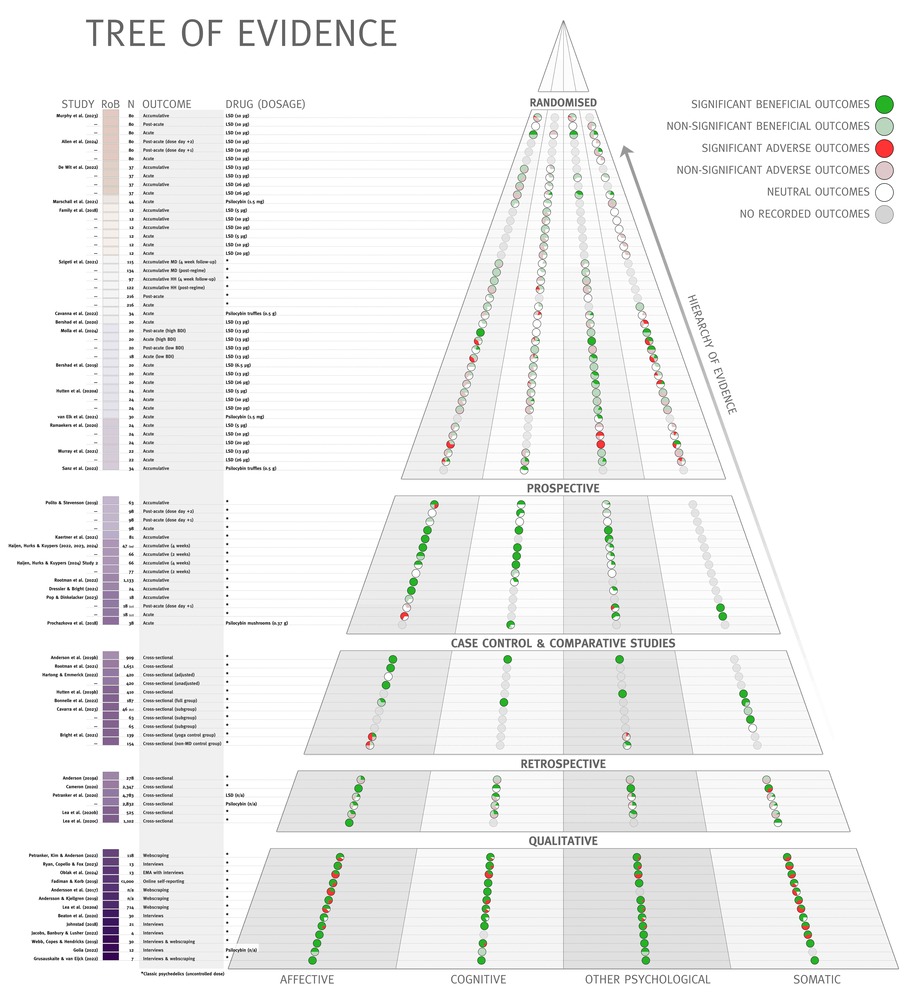 The ToE summarises findings from individual microdosing studies into pie charts, mapped across research categories and experimental levels, to demonstrate the direction and strength of evidence as experimental control (measured using a risk of bias evaluation) is increased.
Discussion & Conclusions: The ToE reveals that while self-reported benefits from microdosing are prevalent, the inclusion of a placebo-control leads to a substantial reduction in significant effects and increased bi-directionality. When controlled findings are presented at face value rather than relative to placebo, they mirror the overwhelmingly beneficial (green) effects reported in anecdotal and observational studies. This pattern visually highlights that although microdosing is widely perceived as beneficial, current evidence does not conclusively attribute these effects to its pharmacological action. Given the growing media attention and increasing public interest in microdosing as an alternative to traditional medications, careful communication is needed to temper sensationalized claims of therapeutic efficacy. Promoting rigorous research in clinical populations is essential to ensure that personal anecdotes are not mistaken for scientific validation.
In sessions