
Toward effective speech-based depression recognition: investigating data balance and depressive symptom severity in AI approaches
S. Moon1, A. Lee1, E. Jeon1, K. Park2, H. Lee3, S.-W. Kim4, J.-M. Kim4, J.-W. Kim4, M. Jhon4
1Electronics and Telecommunications Research Institute, AI Convergence Research Section, Gwangju, Korea, Republic of, 2Megaworks,Inc, Research, Gwangju, Korea, Republic of, 3Korea University, Biomedical Informatics, Seoul, Korea, Republic of, 4Chonnam National University Medical School, Psychiatry, Gwangju, Korea, Republic of
Background: Although voice has been proposed as a potential biomarker for depression detection, standardized biomarkers that can be widely applied in clinical practice remain insufficient. The advent of big data and artificial intelligence analysis have given rise to a significant increase in research on speech depression recognition (SDR), which is aimed at identifying depressive symptoms from voice. However, existing studies are limited by small sample sizes, which constrain the exploration of diverse analytical methods.
Aims & Objectives: This study aims to investigate how SDR model performance can be improved by constructing balanced datasets that reflect the characteristics of the data, with a focus on data interpretation rather than model fine-tuning.
Method: A total of 3425 participants were recruited and their voices were recorded as they read a predefined paragraph aloud. We evaluated classification performance by adjusting the thresholds between normal and depressive symptom groups based on PHQ-9 scores, exploring various combinations of these thresholds. Classification was performed using a Random Forest model, complemented by additional models such as Deep Neural Networks and XGBoost, all evaluated with nested cross-validation. Using these imbalanced datasets and a balanced dataset matched to the sample size of the depressive group, we measured classification performance using random forests for each set.
Results: The classification performance yielded suboptimal results on imbalanced datasets. However, when evaluated on balanced data, the model demonstrated a clearer potential for distinguishing between the groups, suggesting that classification is more feasible under balanced conditions.
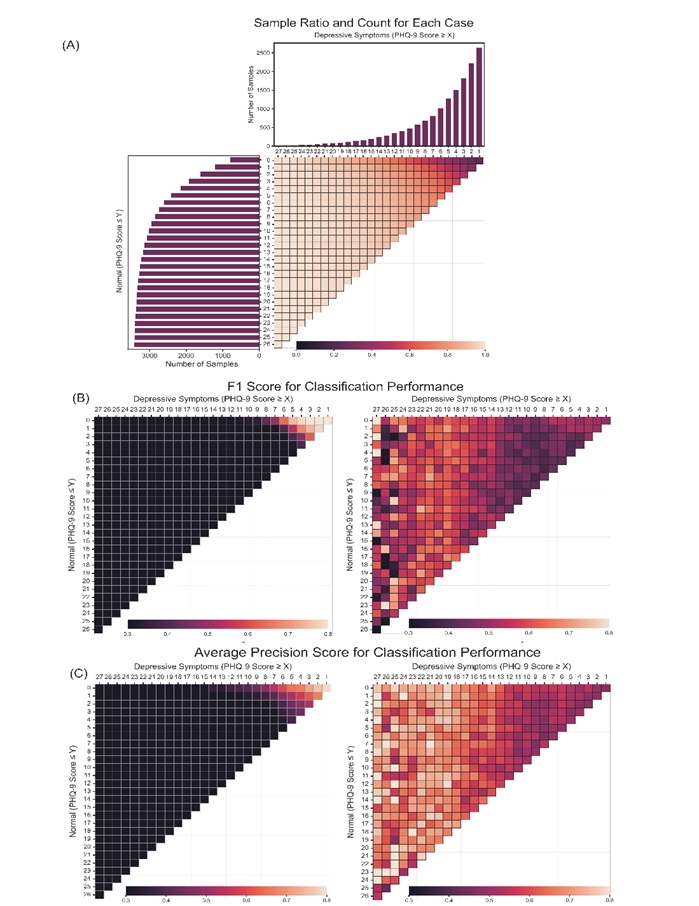
Discussion & Conclusions: To enhance model learning in SDR research, the crucial point may be not only a large sample size but also balancing the dataset based on the severity of depressive symptoms.
In sessions