
Clinical experiences with esketamine treatment at the department of psychiatry and psychological medicine, University Hospital Centre Zagreb, during the period from 2022 to 2024
M. Živković1,2, M. Škaro1, P. Šimara1, I. Stefanović2, A. Mihaljević-Peleš2, D. Degmečić3,4
1University of Zagreb School of Medicine, Department of Psychiatry and Psychological Medicine, Zagreb, Croatia, 2University Hospital Centre Zagreb, Department of Psychiatry and Psychological Medicine, Zagreb, Croatia, 3Josip Juraj Strossmayer University of Osijek, Faculty of Medicine in Osijek, Department of Psychiatry, Osijek, Croatia, 4Clinical Hospital Center Osijek, Department of Psychiatry, Osijek, Croatia
Background: Treatment-resistant depression (TRD) occurs in about 30% of patients with major depressive disorder who have not achieved an adequate therapeutic response after two or more lines of treatment with antidepressants during a sufficient period of time and at the appropriate dose. Esketamine in combination with an oral antidepressant is the first antidepressant approved for TRD.
Aims & Objectives: The aim of this study is to present the clinical experience of esketamine treatment at the University Hospital Centre Zagreb in the period from October 27, 2022, to November 5, 2024.
Method: The study utilized a retrospective approach, collecting anonymized data from the hospital information system. Institutional ethical approval was obtained. Data were analyzed using descriptive statistical methods in Microsoft Excel.
Results: A total of 37 patients were included, of whom 13 were male (mean age: 44 years) and 24 female (mean age: 51 years). The most commonly used antidepressants prior to esketamine treatment were duloxetine (N=18), venlafaxine (N=16), sertraline (N=15), bupropion (N=15), and vortioxetine (N=15). Esketamine was predominantly administered at a dose of 56 mg (N=26), followed by 84 mg (N=9) and 28 mg (N=2). Regarding treatment duration, 28 patients completed the induction phase (MADRS score=16), while 12 patients completed 12 months of treatment (MADRS score=13), 6 completed 18 months (MADRS=16), and 1 completed 24 months (MADRS score=16). Reported side effects included dissociation (N=11), arterial hypertension (N=1), and blurred vision (N=1).
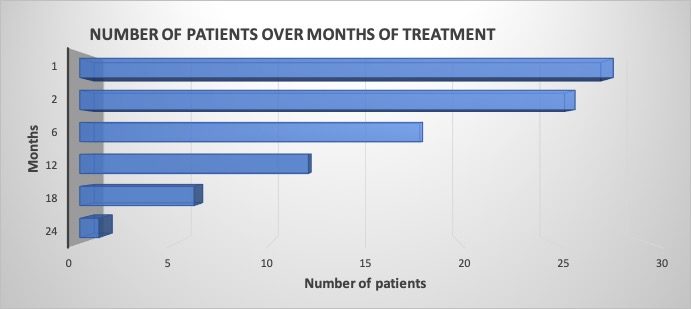
Discussion & Conclusions: The outcomes of our study on the efficacy and safety of esketamine in the treatment of TRD are consistent with short-term esketamine studies (TRANSFORM 1, 2, and 3). After one year of follow-up, 32% of patients achieved a therapeutic response, and 22% achieved remission, which differs from the results of previous SUSTAIN 1 and 2 studies, where remission was observed in 58% of patients, and therapeutic response in 76%. This discrepancy in long-term outcomes is likely attributable to the small sample size. The most frequent adverse event was dissociation, aligning with previous studies. Esketamine presents the innovative modality for TRD treatment and may contribute to significant clinical improvements for this therapeutically challenging group of patients.
In sessions