
Differences in the effects of antipsychotic drug-induced hyperprolactinemia in adolescent and adult schizophrenia patients: a retrospective pilot study
L. Zhang1, L. Zhou1, Z. Huang1, H. Li1
1Shanghai Mental Health Center, Department of Psychiatry, Shanghai, China
Background: Hyperprolactinemia induced by antipsychotics with mental disorders in children and adolescents will affect their growth and development, which has an impact on treatment and prognosis. Previous studies have shown that children and adolescents are more likely to develop hyperprolactinemia than adults, but the risk factors between children and adolescents and adults are unclear.
Aims & Objectives: The aim of this study was to investigate the risk factors of antipsychotic-induced hyperprolactinemia and compare the differences between adolescent and adult schizophrenia patients.
Method: This study included all patients diagnosed with schizophrenia from the hospital electronic medical record system in Shanghai Mental Health Center. A total of 2 045 adolescent patients were matched to adult patients in this study. Hyperprolactinemia(HPRL) was defined as fasting venous blood PRL ≥25ng/mL in children and adolescent, and ≥30ng/mL in adult. We performed a propensity score calibration,where the propensity score was estimated as the gender,disease course and psychiatric medication. With this score, we performed propensity score matching with a 1-to-1 match on the nearest neighbor. Then all variables in the paired adult and child groups were included in the lasso regression model for variable screening. Finally, the selected characteristic factors was included in the random forest (RF) model to establish the prediction model, and the relative importance of each independent variable was obtained. And the data were randomly divided into training set (75%) and testing set (25%) for internal validation.
Results: In adolescent, the top three factors for the occurrence of hyperprolactinemia were the duration of aripiprazole treatment, the total dose of antipsychotic drugs other than aripiprazole, and oral aripiprazole. However, the factors were the total dose of antipsychotic drugs other than aripiprazole, the dose of aripiprazole, and taking aripiprazole orally in adult patients. The RF model showed excellent prediction ability, and the area under curve of the training and validation sets, in adolescent ,was 0.954(95% CI: 0.946-0.963) and 0.865(95% CI: 0.834-0.896 ), while 0.977(95% CI: 0.971-0.982) and 0.851(95% CI: 0.818-0.885) in adults.
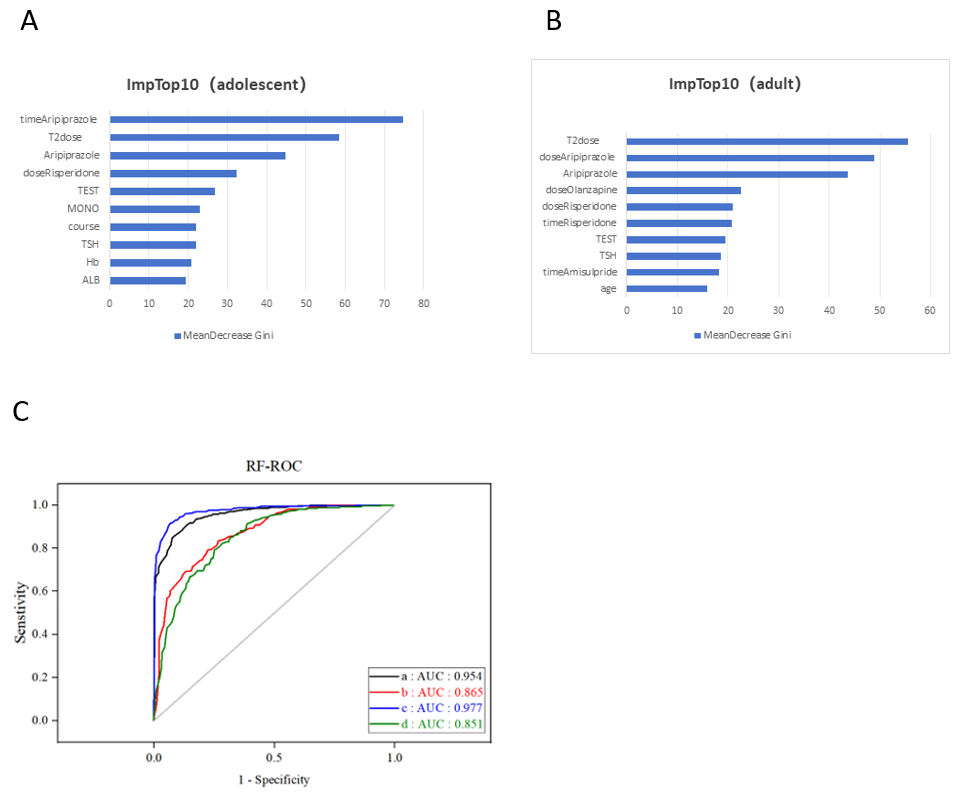
Discussion & Conclusions: The RF model demonstrated excellent prediction capabilities for HPRL, which can prevent the occurrence of HPRL in clinical practice or provide guidance for individualized treatment of different patients.
In sessions