
Age-specific variations in antidepressant efficacy of transcranial magnetic stimulation for treatment-resistant depression: a real-world retrospective study
J.S. Jeng1,2, C.-M. Cheng1,2, M.-H. Chen1,2, M.-N Liu1,2, W.-C. Lin1,2, S.-J. Tsai1,2, Y.-M. Bai1,2, C.-T. Li1,2
1Taipei Veterans General Hospital, Department of Psychiatry, Taipei, Taiwan, 2College of Medicine, National Yang Ming Chiao Tung University, Department of Psychiatry, Taipei, Taiwan
Background: TRD presents a significant clinical obstacle, particularly when addressing the distinctive needs of both youth and elderly populations. This practical challenge depends heavily on real-world research data, and related publications deserve more research.
Aims & Objectives: This study examines the efficacy of TMS treatment in individuals of all ages with TRD and explores potential age-related differences in treatment efficacy across various age groups.
Method: We conducted a chart review of medical records for patients diagnosed with TRD across all ages (range from 15 to 86 years, n=333) who underwent TMS treatment from May 2018 to September 2020, who were categorized into three groups: youth (15-25 years), adults (26-64 years), and elderly (65 years and above). The clinical severity of symptoms was assessed by HDRS-17 and CGI-S and the degree of refractoriness was measured using MSM. The remission rate is defined as HDRS-17 score ≤ 7 and response rates are defined as ≥ 50% improvement on HDRS-17.
Results: The total sample demonstrated a mean improvement of 8.56 scores in HDRS-17 assessments; 37.8% (n=126) met the responder criteria, while 24.3% (n=81) achieved remission (included in responders). There was a significant difference in responder rates. The youth population (44.8%) had the highest responder rate, and adults (38.9%) and the elderly (19.1%) were next, with the elderly exhibiting a lower response rate compared to the youth (p=0.011<0.05).
Table 1: Demographic, clinical characteristics, and treatment parameters, comparison among youth, adults, and the elderly.
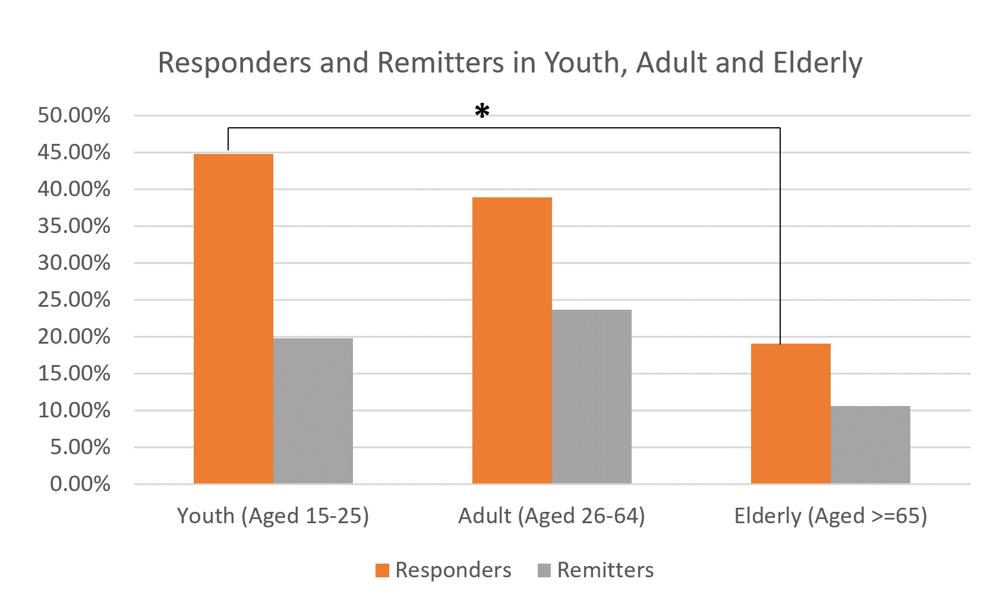 Figure 1: Responders and remitters in youth, adults, and the elderly. (p=0.011<0.05)
Table 1: Demographic, clinical characteristics, and treatment parameters, comparison among youth, adults, and the elderly.
| Variables | Overall (15-86 years) n=333 | Youth (15-25 years) n=96 | Adults (26-64 years) n=190 | Elderly (≧65 years) n=47 | Comparisons F/χ2 | Comparisons p-value |
|---|---|---|---|---|---|---|
| Age (years) [Mean (SD)] | 41.20 (18.46) | 20.57 (2.90) | 44.36 (12.23) | 70.6 (3.94) | 461.855 | <0.001 |
| Female [n(%)] | 210 (63.1%) | 66 (68.8%) | 113 (59.5%) | 31 (66%) | 2.553 | 0.279 |
| HDRS-17 (BL) [Mean (SD)] | 21.73 (6.36) | 21.57 (5.98) | 21.70 (6.56) | 22.19 (6.45) | 0.154 | 0.875 |
| CGI Severity (BL) [Mean (SD)] | 4.82 (0.97) | 4.80 (0.99) | 4.84 (0.97) | 4.74 (0.97) | 0.221 | 0.802 |
| MSM [Mean (SD)]# | 8.44 (1.95) | 8.70 (1.85) | 8.32 (2.05) | 8.38 (1.70) | 1.207 | 0.300 |
| HFrTMS / piTBS (%) [Mean (SD)] | 181 / 152 (54.4% / 45.6%) | 50 / 46 (52.1% / 47.9%) | 100 / 90 (52.6% / 47.4%) | 31 / 16 (66.0% / 34.0%) | 2.977 | 0.023 |
| Stimulation intensity [Mean (SD)] | 65.22(14.70) | 63.31(12.46) | 65.64(15.51) | 67.43(15.41) | 1.419 | 0.243 |
| Numbers_of_TMS [Mean (SD)] | 12.71 (3.70) | 13.15 (3.44) | 12.72 (3.97) | 11.74 (2.88) | 2.282 | 0.104 |
| HDRS-17(BL): 17-item Hamilton Depression Rating Scales (Baseline), CGI: Clinical Global Impression, MSM: Maudsley staging method for refractoriness, HFrTMS: high-frequency repetitive TMS; piTBS: prolonged intermittent theta-burst stimulation. p<0.05 as statistically significant. #N=318, with 16 missing data. | ||||||
Discussion & Conclusions:
The research indicated that elderly patients exhibited lower response rates to TMS treatment for TRD in comparison to youth (44.8%) and adults (38.9%). This supports Zhang et al.'s results that clinical improvement occurs across all age groups, with adolescents performing better. Unlike Zhang et al., our study included TRD patients, suggesting that youth with TRD may also exhibit better responses. This study contradicts Massé-Leblanc et al. that differences may be due to TMS procedure variations. The study's limitations include potential data missing, lack of a control sample, and lack of blinded scale rating procedures. The optimal protocols for youth and elderly populations experiencing TRD require further randomized studies.
In sessions