
The efficacy of deep brain stimulation of combined anterior limb of internal capsule and nucleus accumbens for treatment-refractory obsessive-compulsive disorder: a randomised, double-blinded, and sham-controlled study
J. Cheng1, H. Han1, Q. Fan2, K. Zhuo3, Y. Mao4, J. Hu4, X. Zhang4, L. Lang4, L. Chen4, Z. Wang1
1Shanghai Mental Health Center, Clinical Psychology, Shanghai, China, 2Shanghai Mental Health Center, Rehabilitation Center, Shanghai, China, 3Shanghai Mental Health Center, Functional Neurosurgery, Shanghai, China, 4Huashan Hospital, Fudan University, Department of Neurosurgery, Shanghai, China
Background: OCD is a treatment-resistant mental disorder, with a significant portion of patients not responding to first-line treatments. Deep brain stimulation (DBS) has emerged as a promising therapeutic approach for treatment-refractory OCD.
Aims & Objectives: We assessed the efficacy and safety of a novel combined anterior limb of internal capsule and nucleus accumbens DBS (ALIC-NAc DBS) for treatment-refractory OCD.
Method: This is a randomised, double-blind, sham-controlled study. Participants were diagnosed with OCD, aged between 18 and 65 years, with a Yale-Brown Obsessive-Compulsive Scale (Y-BOCS) score of at least 25. Participants were eligible if undergone adequate trials of at least three first- or second-line medications, combined with at least two augmenting agents, and had received a full course of cognitive-behavioral therapy. Participants were randomly assigned to the active DBS or the sham DBS group for a three-month double-blind treatment phrase. Subsequently, they underwent a 3-month open-label treatment phase, during which participants in both active and sham DBS groups received active stimulation.
Results: Twenty-four patients who met the criteria were recruited and randomly assigned to the active DBS group (n = 12) or sham DBS group (n = 12). For primary outcome, at the 3-month follow-up, 5 participants in the active DBS group (41.7%) and no participant in the sham DBS group responded to treatment, indicating a significant difference (p = 0.047). For secondary outcome, at the 3-month follow-up, the mean Y-BOCS score decreased by 8.58 points (SD 3.86, reduction rate 29.4%) in the active DBS group and by 1.00 points (SD 6.00, reduction rate 3.08%) in the sham DBS group, showing a significant difference between the groups (95% CI 3.32–13.17, p = 0.002). At the 6-month follow-up, after the sham stimulation group had received three months of active stimulation, there was no longer a significant difference in the mean Y-BOCS score reduction between the two groups. A similar trend was observed for the Hamilton Anxiety Scale, Hamilton Depression Scale and Clinical Global Impressions scores. No serious adverse event related to the device occurred.
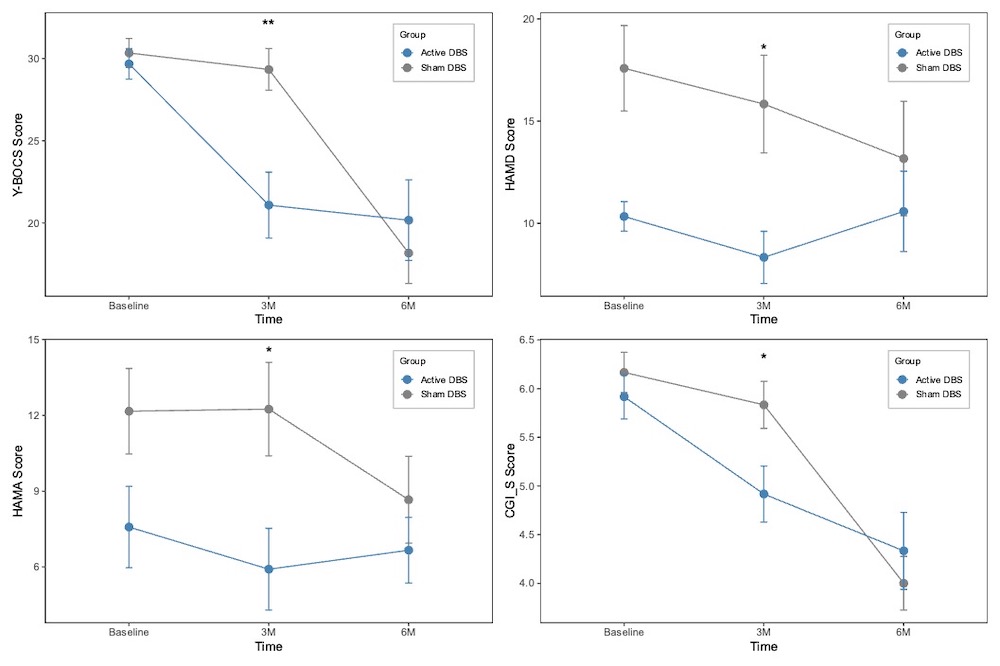
Discussion & Conclusions: Our study demonstrated the efficacy and safety of ALIC-NAc DBS for OCD, providing a promising treatment option for treatment-refractory OCD.
In sessions