
Common and distinct neural substrates of cue craving response between substance and behavioral addiction: a neuroimaging meta-analysis
Q. Zheng1,2, Y. Song1,2, Y. Huang1,2, Y. Sun1,2
1Peking University Health Science Center, Department of Neurobiology, School of Basic Medical Sciences, Beijing, China, 2Peking University, National Institute on Drug Dependence and Beijing Key Laboratory of Drug Dependence, Beijing, China
Background: Cue-evoked craving is the most prominent psychopathological characteristic and the direct cause of relapse for both substance use disorders (SUD) and behavior addictions (BEA). Clarifying the consistent and distinct pattern of the cue-evoked craving responses across different addictions would provide the core evidence to reveal the neural mechanisms of addiction.
Aims & Objectives: We aim to elucidate the common and distinct neural substrates of cue-induced craving between substance and behavioral addictions by neuroimaging meta-analysis. Furthermore, we assessed the effects of abstinence and substance use duration on the craving-related brain response (CR) by subgroup, regression and multimodal analysis.
Method: Adhering to the PRISMA guidelines, we systematically searched whole-brain and case-control functional magnetic resonance imaging (fMRI) studies under cue-reactivity tasks involving substance or behavioral addicts who meet DSM-IV or DSM-V diagnoses or other published scales with high reliability and validity. We employed seed-based d Mapping with Permutation of Subject Images for coordinate-based meta-analysis.
Results: 38 studies (27 SUDs and 12 BEAs) with a pooled sample size of 1787 participants were included. The conjunction of all addiction studies showed higher CR mainly in the right median cingulate and left anterior cingulate (FWE-corrected at P <0 .05). Specifically, SUDs yielded consistently higher CR mainly in the left anterior cingulate and right inferior frontal gyrus, and BEAs mainly in the right superior frontal gyrus and median cingulate. With no significant difference, SUDs and BEAs both showed a heightened cue-induced response in the median and anterior cingulate. Heroin addicts in a non-abstinence state had greater CR in the right inferior parietal and frontal gyrus than those in an abstinence state. Additionally, the duration of substance and methadone use in heroin use disorder was negatively correlated with CR in the bilateral inferior frontal gyrus, left superior parietal and frontal gyrus.
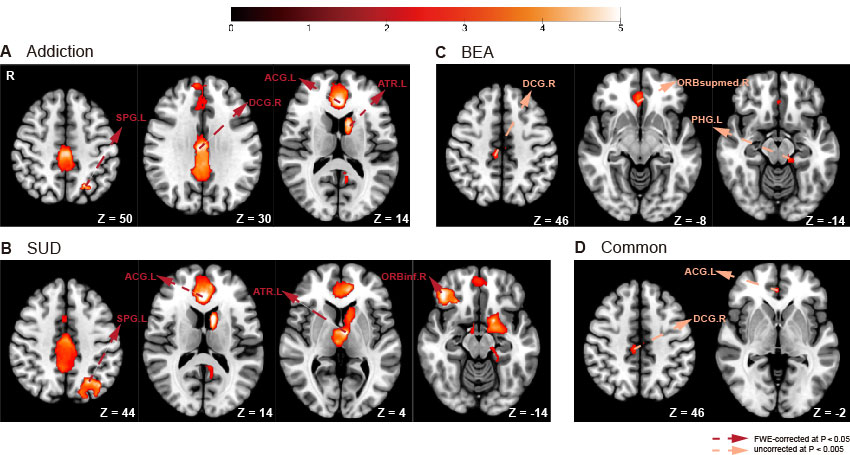
Discussion & Conclusions: This meta-analysis highlights the important role of the median cingulate and left anterior in cue-induced craving for both SUDs and BEAs. The CR of the inferior frontal gyrus would be dampened by the heroin/methadone use time and abstinence. These findings provided insights into the neurobiological mechanisms of addiction and may inform targeted interventions for addictive disorders.
In sessions