
Medication-seeking behaviors and correlated characteristics of Zolpidem users in Taiwan - a shared patient network analysis
W.-C. Lee1, Y.-J. Pan1,2, S.-H. Chang3, Y.-C. Chen3,4
1Far Eastern Memorial Hospital, Department of Psychiatry, New Taipei City, Taiwan, 2Yuan Ze University, Department of Chemical Engineering and Materials Science, Taoyuan City, Taiwan, 3National Yang Ming Chiao Tung University, Institute of Hospital and Health Care Administration, Taipei, Taiwan, 4National Yang Ming Chiao Tung University, School of Medicine, College of Medicine, Taipei, Taiwan
Background: Increasing insomnia signals a public health problem, alongside rising zolpidem use. This study investigates the factors behind the disproportionate rise in zolpidem prescriptions in Taiwan.
Aims & Objectives: It aims to identify the determinants of high-dose zolpidem users in Taiwan’s Yilan County and employ an innovative approach to outline their medication-seeking patterns, using Taiwan’s healthcare database.
Method: The associations between sociodemographic and clinical factors and low-dose and high-dose users were analyzed using multiple logistic regression. Social network analysis was employed to explore medication-seeking behavior among these user groups across different healthcare institutions.
Results: Among 5290 participants, 22.82% are high-dose users. Males have a 1.33-fold higher risk and participants with chronic diseases have more than four times the risk of being high-dose zolpidem users. A social network analysis showed a higher density (0.52) for high-dose users, revealing their frequent visits, for zolpidem, to different healthcare institutions. Psychiatrists have a central role in both low-dose and high-dose user networks, with a greater influence on low-dose users (64.4) than high-dose users (32.2).
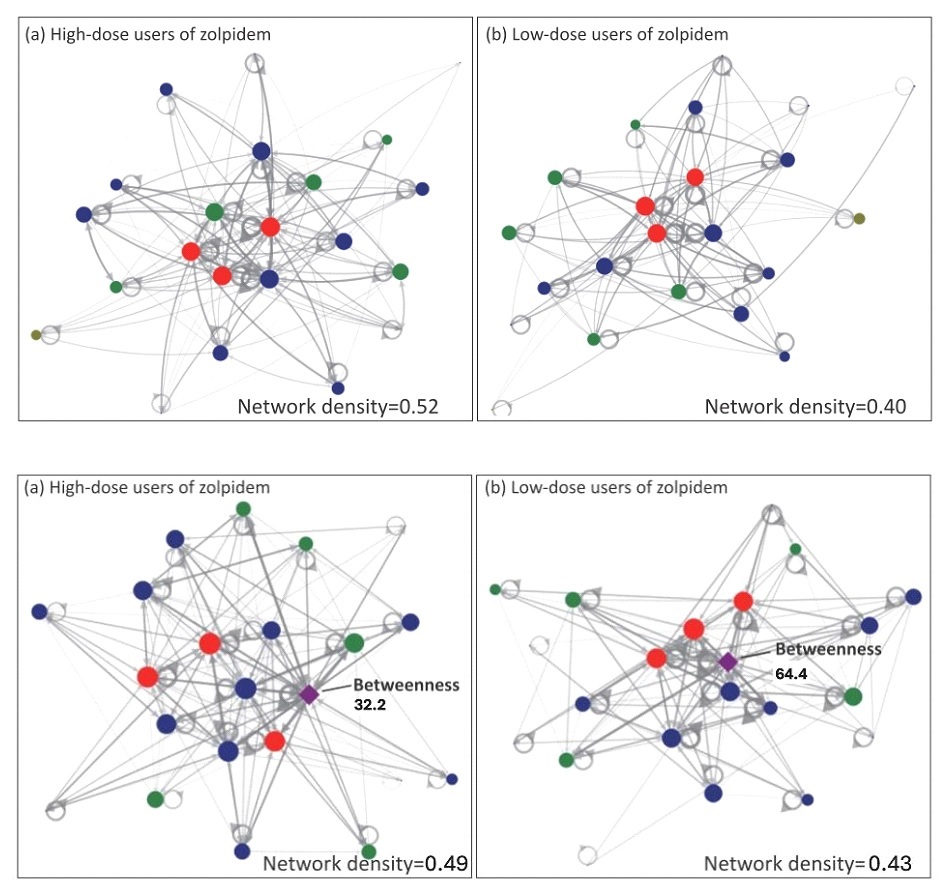
Discussion & Conclusions: Males, individuals aged 40–60 years, and those with chronic diseases, catastrophic illness certifications, economic disadvantages, or mood and physical disorders exhibit a higher risk of high-dose zolpidem use. High-dose users demonstrate frequent doctor shopping and medication refills across institutions. Psychiatrists play a key role in zolpidem-seeking networks but with reduced influence among high-dose users. Social network analysis highlights distinct patterns between high- and low-dose users, emphasizing differing medical needs. These findings guide policymakers in addressing zolpidem-related medication-seeking behaviors effectively.
In sessions