
Using Classification and Regression Tree Modelling to Investigate Low-Dose Ketamine's Effect on Remission of Suicidal Symptoms Among Patients with Treatment-Resistant Depression and Strong Suicidal Thought
P.C. Wu4, W.C. Lin4,1, T.P. Su4,2, C.T. Li4,3, H.J. Wu4, S.J. Tsai4,1, Y.M. Bai4,1, P.C. Tu4,1, W.C. Mao2, M.H. Chen4,1
1Taipei Veterans General Hospital, Department of Psychiatry, Taipei, Taiwan, 2National Yang Ming Chiao Tung University, Division of Psychiatry, Faculty of Medicine, Taipei, Taiwan, 3Cheng Hsin General Hospital, Department of Psychiatry, Taipei, Taiwan, 4National Yang Ming Chiao Tung University, Institute of Brain Science, Taipei, Taiwan
Background: As accumulating evidence suggests ketamine's antisuicidal properties, there has been growing interest in elucidating its underlying mechanisms and predictive factors for treatment response. However, the predictive power of several demographic and clinical characteristics varied across previous studies. Additionally, some potential predictors, such as baseline depression severity and suicidal ideation, may have a positive correlation with each other, and thus their collinearity may interfere with regression analysis, making it challenging to predict the antisuicidal effect of ketamine infusion by a single factor.
Aims & Objectives: Using a classification and regression tree (CRT) analysis, this study aims to develop a predicted probability composed of various potential predictors to investigate the effect of ketamine infusion on remission of suicidal symptoms among treatment-resistant depression (TRD) patients.
Method: Using data from our previous randomized placebo-controlled and open-label trials, this study included 67 TRD patients with strong suicidal thought receiving a single ketamine infusion of 0.5 mg/kg for the post-hoc analysis of the rapid (Day 1 240 min postinfusion) and sustained (Day 2 postinfusion) antisuicidal effects of low-dose ketamine infusion. Demographic and clinical characteristics at baseline were assessed as potential predictors in a CRT model for the antisuicidal response to ketamine infusion.
Results: Combinations of clinical predictors, including mild or moderate depression severity, shorter duration of the current episode, no more than 4 trials of antidepressant failures, low or moderate current suicide risk, and history of suicidal attempt, offered superior predictive power for the rapid and sustained antisuicidal effects of low-dose ketamine infusion, outperforming the predictive power of any individual predictor.
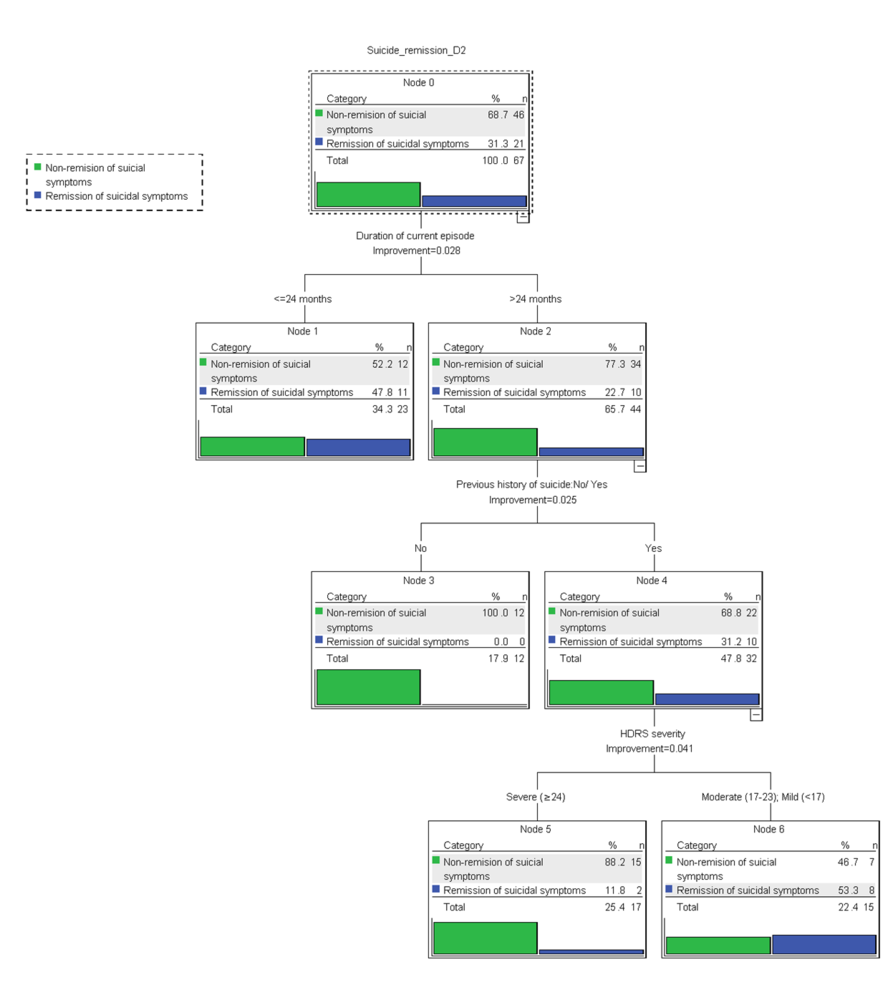
Discussion & Conclusions: The results are beneficial for clinicians in identifying individuals who are most likely to respond favorably to ketamine’s antisuicidal effect. Further research may be necessary to corroborate these findings.
In sessions