
Differences in Changes of Peptide Antigen-Related Antibody Levels Between Remission and Non-Remission Groups After One Year of Antipsychotic Treatment in Drug-Naïve First-Episode Schizophrenia Patients
Y. Zheng1, J. Du2, C. Pu1, X. Yu1
1Peking University Sixth Hospital, Clinical Research Department, Beijing, China, 2Nanjing Brain Hospital affiliated to Nanjing Medical University, Department of Psychiatry, Nanjing, China
Background: Autoimmune dysfunction plays a crucial role in the pathogenesis of schizophrenia, with abnormalities in peptide antigen-related IgG levels observed in patients, significantly differing from those in healthy individuals. Although previous studies have suggested a correlation between peptide antigen-related IgGs and the symptoms of schizophrenia, research on the relationship between these IgGs and treatment outcomes in first-episode schizophrenia (FES) patients remains insufficient.
Aims & Objectives: This study examined the relationship between changes in peptide antigen-related IgG levels and one-year treatment outcomes in FES patients.
Method: Sixteen peptide antigen-related IgGs from proteins encoded by schizophrenia-related genes were selected on the basis of several selection criteria from a 2022 genomewide association study. Novel peptide antigen-related IgG levels were measured in drug-naïve FES patients at baseline (n = 155). At the one-year follow-up, 57 patients completed both symptom and autoantibody assessments. Statistical analyses included t tests, Pearson correlation analysis, linear mixed-effects models, and simple slope analysis.
Results: At the one-year follow-up, MOB4 IgG levels were negatively associated with PANSS item P2 scores (r = −0.54, Bonferroni-adjusted P = .029) and item P5 scores (r = −0.65, Bonferroni-adjusted P < .001). Anti-MAD1L1 IgG levels were significantly higher in the remission group compared to the non-remission group (B = −0.14, P = .017), with no notable changes over time. Anti-FURIN IgG levels exhibited divergent trends between the remission and non-remission groups (interaction: B = −0.06, P = .049). Anti-MAPK3 IgG levels were lower in the remission group (B = 0.11, P = .032) but showed a more pronounced rate of increase over time in this group (interaction: B = −0.08, P = .012). Similarly, anti-ACTR1B IgG levels increased significantly in the remission group (interaction: B = −0.07, P = .048).
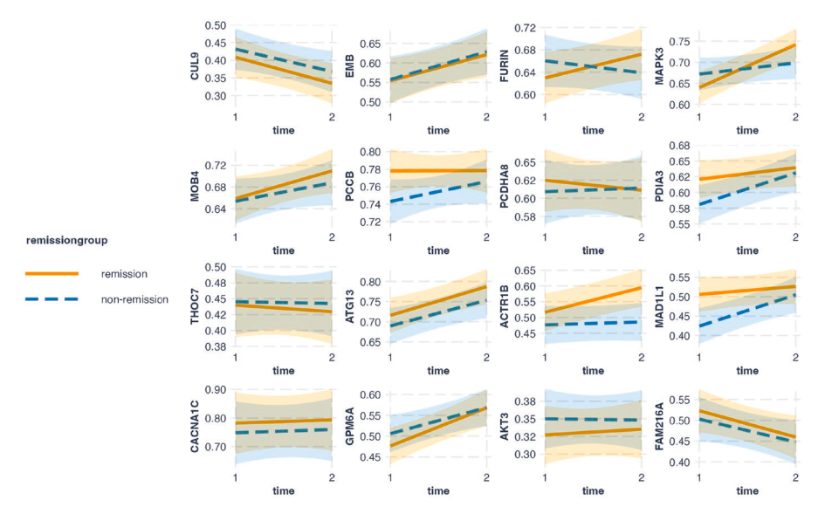
Discussion & Conclusions: This study underscores the potential of peptide antigen-related IgGs as biomarkers for predicting antipsychotic drug(APD) treatment outcomes in drug-naïve FES patients. Our study observed decreased levels, possibly reflecting APD effects and disease state differences. Changes in antibody levels over one year were correlated with treatment outcomes, highlighting APD-induced immune modulation.
In sessions