
Psilocybin with Psychotherapeutic Support for Treatment-Resistant Depression: A Pilot Clinical Trial
S. Meikle1,2, O. Carter1, P. Liknaitzky3,4, L. Johansen2, R. Iyer2, N. Strauss2, M. Williams4, D. Castle5, S. Rossell2
1University of Melbourne, Melbourne School of Psychological Sciences, Melbourne, Australia, 2Swinburne University of Technology, Centre for Mental Health & Brain Sciences, Melbourne, Australia, 3Monash University, Department of Psychiatry, School of Clinical Sciences, Melbourne, Australia, 4Monash University, School of Psychological Sciences, Melbourne, Australia, 5University of Tasmania, Centre for Mental Health Services Innovation, Melbourne, Australia
Background: Depressive disorders are a major global health challenge, with many individuals unresponsive to existing treatments or left with residual symptoms such as impairments in cognition and social functioning. Emerging psychedelic therapies show promise for treating depression but require further research.
Aims & Objectives: This pilot study aimed to evaluate the feasibility, safety, and preliminary efficacy of psilocybin with psychotherapeutic support for treatment-resistant depression (TRD). It also sought to investigate potential predictors of treatment outcomes, explore the broader effects on cognition and social processing, and deepen understanding of individual variability in participant experiences.
Method: Treatment consisted of two 25mg psilocybin sessions, with three preparatory and six integration sessions. Depression severity was assessed using the Quick Inventory of Depressive Symptomatology (QIDS) at 3-weeks post-dose 2 (primary endpoint) and at 20 weeks post-dose 2 (long-term follow-up). Potential predictors of clinical outcomes were evaluated using questionnaires, and qualitative interviews were used to capture individual experiences. A comprehensive task battery assessed processing speed, verbal fluency, learning and memory, executive function, cognitive flexibility, emotion identification, affect sharing, and self-other differentiation, alongside self-report assessments of broader socio-emotional functioning (pending analysis).
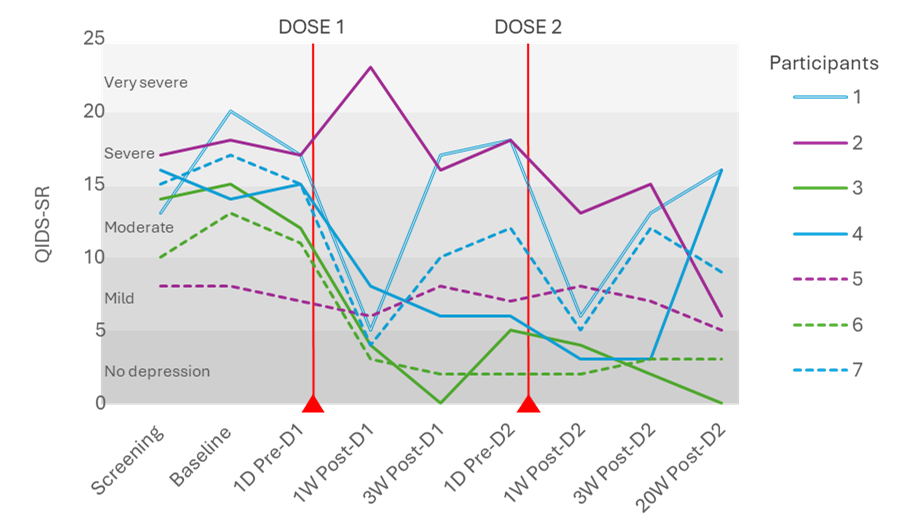
Results: We observed a clinically meaningful reduction in depressive symptoms at the primary endpoint (mean change = -7.14; p = 0.02; Hedge’s g = 1.41; 95% CI [0.10, 2.71]), and the long-term follow-up. Examining individual participant data (n=7) revealed diverse response patterns. Two participants displayed a sustained treatment response, three relapsed, and two exhibited no substantial improvement (figure 1; green, blue and purple, respectively). Mindset prior to dosing, and spiritual experiences and perceptual shifts during dosing were identified as possible predictors of treatment trajectory - further supported by qualitative data, while treatment expectations did not influence outcomes.
Discussion & Conclusions: Findings add to the growing evidence base for psilocybin therapy and provide direction for further research focusing on individual variability in response to better tailor treatments and enhance efficacy. Outcomes related to cognition and social functioning will provide insights the potential of psilocybin therapy to target a wider spectrum of symptoms and enhance understanding of its mechanisms.
In sessions