
Impacts of Taiwan’s National Health Insurance Dedicated Budget Policy on Long-Acting Injectable Usage: An Interrupted Time-Series Analysis
G.H.-M. Wu1, F.-C. Chen2, T. Huang1, D.-J. Li3, N. Chang1, E. Chen4, H. Qiu5, C.-C. Chang3, Y.-Y. Wang6, H.-Y. Lee7, F.H.-C. Chou8
1Global Epidemiology, Office of Chief Medical Officer, Johnson & Johnson, Taipei, Taiwan, 2Information Section of the Planning Department, Kaohsiung Municipal Kai-Syuan Psychiatric Hospital, Kaohsiung, Taiwan, 3Department of Addiction Prevention and Treatment, Kaohsiung Municipal Kai-Syuan Psychiatric Hospital, Kaohsiung, Taiwan, 4Medical Affairs, Johnson and Johnson, Taipei, Taiwan, 5Global Epidemiology, Office of Chief Medical Officer, Johnson & Johnson, New Jersey, United States, 6Department of Geriatric Psychiatry, Kaohsiung Municipal Kai-Syuan Psychiatric Hospital, Kaohsiung, Taiwan, 7Department of Pharmacy, Kaohsiung Municipal Kai-Syuan Psychiatric Hospital, Kaohsiung, Taiwan, 8Dean's Office, Kaohsiung Municipal Kai-Syuan Psychiatric Hospital, Kaohsiung, Taiwan
Background: Long-acting injectable antipsychotics (LAIs) are reimbursed under Taiwan’s National Health Insurance (NHI) but are underutilized due to budget constraints. To enhance LAI usage, the NHI launched the LAI-dedicated budget policy (LAI-DBP) in January 2022 with NT$2.7 billion in funding. Its real-world impact has not yet been studied.
Aims & Objectives: To assess the impact of the LAI-DBP on prescription rates for first- and second-generation (FGA/SGA) LAIs in patients with schizophrenia/schizoaffective disorder.
Method: Prescription data for 18–65-year-olds with schizophrenia/schizoaffective disorder were obtained from Kaohsiung Municipal Kai-Syuan Psychiatric Hospital electronic medical records between October 2005–September 2024. An interrupted time-series design and Prais-Winsten regression model were used to estimate changes before and after LAI-DBP implementation. The impact of NHI reimbursement for SGA paliperidone palmitate once-monthly/3-monthly (R-PP1M/R-PP3M) on prescribing was also assessed.
Results: Between October 2005 and R-PP1M, overall LAI prescriptions decreased by -0.03 percentage points per month (pp/m) (P<0.0001). R-PP1M and R-PP3M were followed by significant increases of 0.08 pp/m. After LAI-DBP implementation, overall LAI prescriptions increased by 0.19 pp/m, increasing the proportion of LAIs to 33.2% of all antipsychotic prescriptions by September 2024. In parallel, FGA-LAI prescriptions decreased over time, with significant trend changes following R-PP1M (-0.06 pp/m) and LAI-DBP implementation (-0.15 pp/m). SGA-LAI prescriptions rose 0.2% pp/m to account for 27.8% of all antipsychotic prescriptions by September 2024, with significant trend changes after R-PP1M (0.02 pp/m), R-PP3M (0.11 pp/m), and LAI-DBP implementation (0.35 pp/m). The model predicted that LAI-DBP resulted in a 24.0% increase in all LAI prescriptions (-40.3% for FGA-LAI, +68.1% for SGA-LAI).
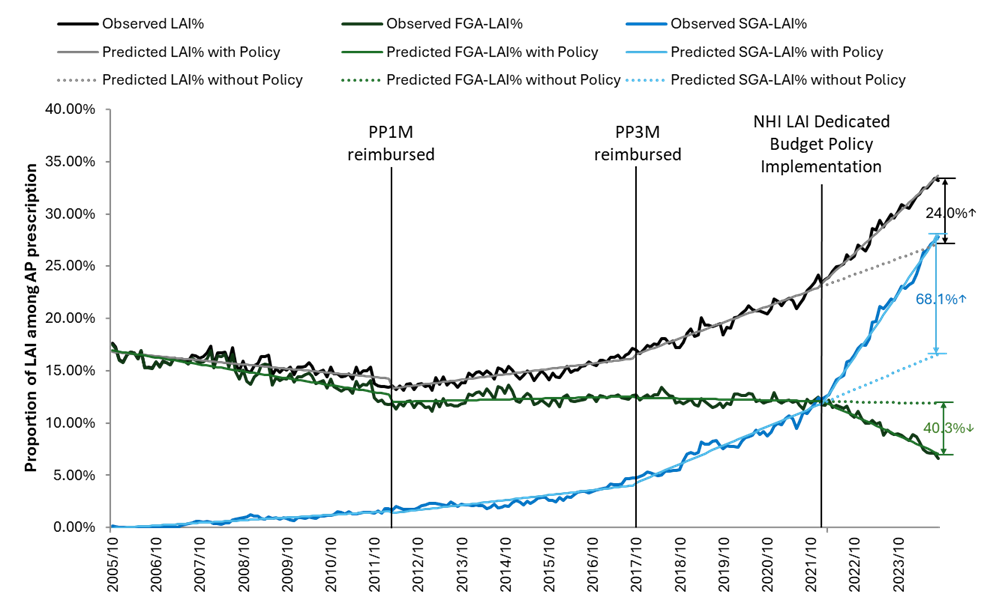 Figure. Trend of LAI Usage
Discussion & Conclusions: The LAI-DBP significantly increased the proportion of antipsychotic prescriptions using any LAI and SGA-LAIs and had a greater impact than R-PP1M and R-PP3M. LAI prescriptions account for approximately one-third of all antipsychotic prescriptions, suggesting that, in addition to financial support, other strategies may be needed to overcome obstacles to their uptake.
In sessions