
Adolescent THC Exposure Enhances Impulsivity in Adulthood: Insights from a WIN 55,212-2 Self-Administration Mouse Model
E. Martín-García1,2, M. Cajiao-Manrique1, R. Maldonado1
1Universitat Pompeu Fabra, Medicina i Ciències de la Vida, Barcelona, Spain, 2Universitat Autònoma de Barcelona, Psicobiologia i Metodologia de las Ciències de la Salut, Barcelona, Spain
Background: Cannabis addiction is a chronic, relapsing disorder for which effective treatments remain unavailable. Regular cannabis use often begins during adolescence, and early exposure to cannabinoids may heighten the risk of addiction in adulthood.
Aims & Objectives: This study explores the impact of adolescent exposure to Δ9-tetrahydrocannabinol (THC), the primary psychoactive component of cannabis, on addiction-like behaviors in adult mice.
Method: Male mice were exposed to THC (5 mg/kg) daily from postnatal days 37 to 57. In adulthood, mice underwent operant self-administration sessions of WIN 55,212-2 (12.5 μg/kg/infusion) for 10 days and were evaluated for addiction-like criteria, including persistence of response, motivation, and compulsivity. Additionally, two parameters related to craving (resistance to extinction and drug-seeking behavior) and two vulnerability traits for addiction (impulsivity and reward sensitivity) were assessed. Gene expression analysis via qPCR was performed in the medial prefrontal cortex (mPFC), nucleus accumbens (NAc), dorsal striatum, and hippocampus (HPC) to identify differentially expressed genes in addicted versus non-addicted mice.
Results: Adolescent THC exposure did not influence WIN 55,212-2 reinforcement or the development of addiction-like behaviors. However, THC-exposed mice exhibited heightened impulsivity in adulthood, with this trait being more pronounced in mice meeting addiction criteria. Gene expression analysis revealed downregulation of drd2 and adora2a in the NAc and HPC of THC-exposed mice. Additionally, drd2 expression was downregulated in the mPFC of vehicle-treated mice that developed addiction-like behaviors.
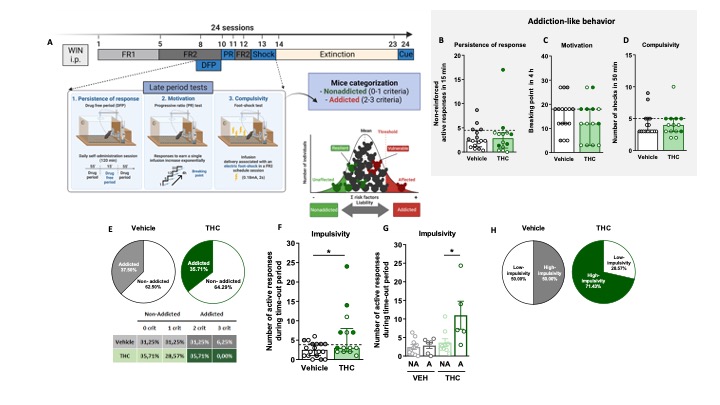
Discussion & Conclusions: These findings suggest that adolescent THC exposure increases impulsivity-like behavior in adulthood, potentially through alterations in drd2 and adora2a expression in key brain regions.
In sessions